Showing posts with label money. Show all posts

Tuesday, April 3, 2012

Mixed review 4-2-12 (get in on the gen jam)


The Mixed review is a record of my daily readings. I hope it provides a resource for your own projects and projections into the intricacies of our world.

The 1st Item of the night is: Umberto Eco's Anthropology of the West.(wiki)

Wikipedia reports that in 1988 Uberto Eco founded an organization called Anthropology of the West for the development of anthropological study of "western" society by their "non-western" counter part. This would balance out the advantage that "western" anthropologist gain from their long standing monopoly in defining the "non-western" cultures. Wikipedia reports Eco's prepares in starting the organization as "developed this trans cultural international network based on the idea of Alain Le Pichon in West Africa." This all sounds great except one thing, there is no situation for any of these clam, (check it out for your self). I'm shore it's just an over site but there you have it. I have to say this Anthropology of the West thing sounds pretty rad! It serenely be a phenomenal rescores of diversified knowledge. If anyone knows any more about it they should let me know.


Something else I learned tonight is that Eco has published children's books on the topic of semiotics. Man! it would have been awesome growing up understanding the role that words(signifiers) take in forming meaning through their attachment to ideas(signified) in the mind, and these attachments make up units called signs that form associations and meaning through their differences.  I guess one of these books the Bomb and the General is about the escape attempts of a group of atoms that were imprisoned by a diabolical military general, the general confide the atoms in nuclear war heads in his Attic. 

The 2st Item of the night is: Chapter 14 "Money" in Understanding media by Marshall Mcluhan.

For Mcluhan money shares one nature with everything that is its a medium that both communicates, and that that communication is never neutral. Understanding media states "'money talks" because money is a metaphor, a transfer, and a bridge. Like words and language, money is a storehouse of communally achieved work, skill, and experience. Money, however, is also a specialist technology like writing; and as the clock visually separates time from space, so money separates work from the other social functions. Even today money is a language for translating the work of the farmer into the work of the barber, Doctor, engineer, plumber. As a vast social metaphor, bridge, or translator, money-like writing-speeds up exchange and tightens the bonds of interdependence in any community. It gives great spatial extension and control to political organizations, just as writing does, or the calendar. It is action at a distance, both in space and in time. In a highly literate, fragmented society, "Time is money," and money is the store of other people's time and effect." Money separates in that it crates the devotion of labor or makes so activities more "worthy" of its benefits while leaving other activities to those that want to wast time, and on the other hand draws divergent tasks into one economy or "storehouse" of "communally achieved work, skill, and experience. 

Understanding media also presents two main types of money: commodity, and currency.
According to this writer, commodity economies are the older of the two. Some of the examples of commodities given are whales’' teeth on the island of Fiji and rats on Easter Island. The writer sites circumstances where "literate" cultures go back to commodity economies; "The Dutch, after the German occupation of World War II, were avid for tobacco."

Understanding Media clams that "money always retains something of its commodity and community character." The writer clams that voluntary release in children comes whith their development of speech and he then relates this to the currency economies lose grasp on commodities in favor of currency exchange.
"Currency is a way of letting go of the immediate staples and commodities that first serve as money, in order to extend trading to the whole social complex." He relates the speed of currency to the development of the phonetic alphabet. "money, like writing, has the power to specialize and to rechanneled human energies and to separate functions, just as it translates and reduces one kind of work to another. Even in the electronic age it has lost none of this power."

"The use of a commodity such as money naturally increases its production." Vergina around the time of the revolution made "European currencies quite dispensable," Presumably by over printing or maybe by refusing it as a means of paying taxes. As a response to the monitory debasement the Virginians legislated tobacco as legal tender which in turn lead to an increase in tobacco production.

Smuel Butler relates the "faith" required to maintain a paper currency to a religious sacrament, and even canonizing wealth as sainthood in this new religion of "prosperity." - a look glimpse forward to the future prosperity gospel of our modern times.

The thing that I think McLuhan overlooks in all this is the degree to which even a currency economy depends on the value of fungible commodities for its stability and health. That indeed even in currency economy fungible commodities like crude oil make up the majority of economic transaction, and when a exchange value of a commodity out passes its use value then we get financial bubbles. What I'm saying is that to the degree to which an economy is based on the pure exchange of currency this economie's commody market will be over inflated.


The 3ed itum of the night is: The art of Joan MirĂ³ & Ed Kienholz.

I'm going rename the paintings what I want to because it looks like a rorschach.


Permaculture farm doin’ the symbioses jitter.

Even natural things are gettin' into the evil pollution mad house since the epic gen jam last Monday!!!


                                                             This one's Ed Kienholz
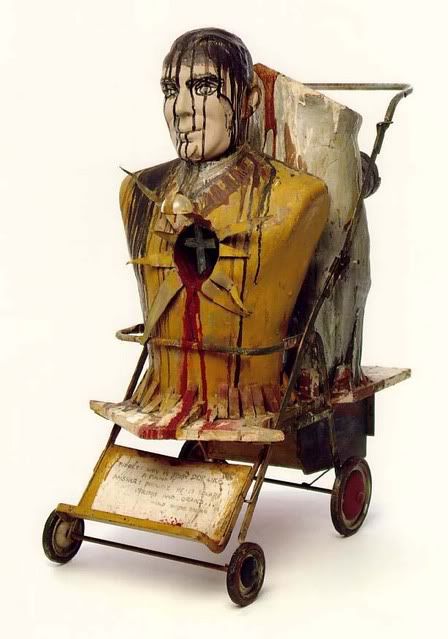
                                                                  
                                                   
                                                     It rains on the just and unjust alike.


Thursday, March 29, 2012

Mixed review 3-29-12


Capital by Karl Marx is a 3 part series that outlines the role of money in society. Capital 1 mainly deals with monetary exchange and how it relates to the commoditization of Labor (not exactly what the wiki states but I've lessened to it on online audio so I know what it’s about). Capital 2 deals with the role of borrowing and lending in the capitalist system (this is of spatial interest to me as banking is kind of my pet project).
Capital 3 spells the end of capitalism claiming that this when the required production increases do to growth, the rate of profits tend to fall. Here’s a link to the audio version of Capital 1(http://librivox.org/capital-volume-1-by-karl-marx/)

2. Money and money Reforms by Christ JelsetThis little booklet is a Marxian history of money from the times of barter through the early days of mercantilism on into our current credit system. It is clear concise and to the point with real numbers and a few dates.

Tonight’s reading:
The Capter Paper Currency outlines the development of proto bank notes into paper money. In the days before banking gold smiths would store gold as a serves. The gold smiths would issue receipts that where then used as currency. The writer claims that at first the gold smith would charge a serves fee but do to completion the fee lowered until goldsmiths adopted the practice of charging interest instead (I wonder if there’s a difference between a holders fee and interest). The gold smith’s began investing the holding, "as long as the custodian was a prudent business man and successful in his undertaking, he would not only be able to satisfy all claims and thus avoid prosecution for fraud, but he would be building a fortune for himself as well."

The writer presents a couple models of paper currency, the first of which is a convertible paper money backed by a full gold reserve. The writer claims that the "only purpose for convertible money is to keep the precise metals from the wear and tear of circulation. Than he claims that "this method will prevent depreciation of the currency even more than the circulation of gold itself." Then he claims that it lacks elasticity (which I consider to be economist code for inflation). Finally this method is often suspended by governments in times of crisis to keep their gold reserves form depleting. Also some thing that must be noted is that custodians (bankers) where using reserves for their oun gain.

The writer reports the other extreme to be inconvertible paper money, (it seems to me that the other extreme would be pure fiat money and not another form of backed currency but whatever). In spite of the fact that the writer sites 1933 legislation providing the authority to issue paper beyond corresponding reserves he does not mention the Federal Reserve act of 1913 which galvanized the practice of fractional reserve lending.

In the last paragraph of the chapter the writer says that "in 1933 there seemed to be a great shortage of currency. In 1938 the banks were bulging with excess reserves. But the economic security of the masses of the population had not been established". Thus increasing the money supply does not benefit the public.

For more on the use of paper money check out American dream film-full Length on youtube(http://www.youtube.com/watch?v=tGk5ioEXlIM)
This video gives a fast over view of banking from the Austrian school perspective, and I think it would make a great supplement to this and other Marx's readings of money precisely because it comes from the other end of the political spectrum.
3. An Enquiry Concerning Human Understanding by David Hume

Section IV SCEPTICAL DOUBTS CONCERNING THE OPERATIONS OF THE UNDERSTANDING  part I says to us "the observation of human blindness and weakness is the result of all philosophy, and meets us at every turn, in spite of our endeavors to elude or avoid it." There for the disruption of prejudges is a primary purpose or effect of philosophy.

This text derails the assumption that facts can be discovered through the operation of thought alone.
It also proclaims that true knowledge can only be gained through the observance of cause and effect together and that we can’t predict effects from the observations of effects nor know the cause from which an effect comes. The text uses the example of light; we would not know from observing the light of a fire that it could burn us unless we experienced the effect of burning on our skin that fire causes when we touch it.

One place in the text states "When I see, for instance, a billiard ball moving in a straight line towards another, even suppose motion in the second ball should by accident be suggested to me, as the result of their contact or impulse, may I not conceive, that a hundred different events might as well follow from that cause?" I have to admit when I read this I imaged the second billiard ball turning into a kangaroo upon impact, then putting on a rene descartes mask and jumping into a lamborghini diablo and speeding off. I'm assuming that the un-likeliness of this actuality accruing will be covered in chapter 6, Of Probability. 

4.Incinerate by sonic youth


Wednesday, March 28, 2012

Mixed review 3-28-12

I'm going to start posting my nightly readings and a few words of opinion on their contents.


Money and money Reforms by Christ Jelset
This little booklet is a Marxian history of money from the times of barter through the early days of mercantilism on into our current credit system. It is clear concise and to the point with real numbers and a few dates.

Tonight I read the chapters entitled, Government Regulation of Money, and An adequate supply of Money,

The chapter "Government Regulation of money" traces the development of governmental rule concerning the value of coins from the setting of standard waits of value, through the discovery that wait need not correspond to the inscribed value, and re-minting prices, to the governmental changing of wait requirements.

When it was discovered that coins that had been worn to a degree that their inscribed wait no longer corresponded with their actual wait it was then that governments realized that they could control the difference between wait requirement and inscribed value through the rule of law.

At this point in my reading it seems that the writer is unaware of the U.S. current fiat money system when he says "(about non backed currency) This too has had its trial in practical application, but with less success. Governments in distress, as e. g., when wars are carried on, have resorted to paper issues of currency when gold was no longer available as backing. Such practices have automatically raised prices and, if the practice were carried far enough, values represented have disappeared altogether as in Germany following World War I." The writer goes on to identify debtor's as likely to support inflationary printing of money on account that the new money could be used to pay off their debts. (oh! I looked in front of the booklet and now see that it's copyright was 1947 that’s 24 years before Nixon took the U.S. of the Gold standard, so that explains the writers unawareness of current monetary policy.)

Also as a point of personal interjection
While it seems to be true that an increase in money supply could benefit doubters if they manage to use it to pay off their debt, on the other hand the new money would lose buying power in other regards, and if the debtor defaults in spite of the increase in money supply their compounding debt would then increase by the reverse of the value los of the debt plus penalty fees.

The chapter "An adequate Supply of money" presents the labor theory of value in relation to exchange between commodities, the velocity of use in relation to value, the medium of exchange vs. means of payment, the distribution of money, the inequity of the labor market, and the question of who should control monetary policy.

All the topics covered in this chapter are interesting but I'm only going to pick one for the sack of brevity.
The theme of inequity in the labor market is definitely a defining one for Marx. The writer clams that the labor market came about because hand produced "goods" couldn’t compete with "mass production" so workers unable to sell their products at a market price had to sell the labor instead. The writer calms that in regards to the exiting  of money for labor compared to the exchange of goods that "The one is an exchange of equivalents between social equals. The latter, too, is an exchange of equivalents but between unequal’s." What the writer means is that the laborer is at a saver disadvantage because if the commodity market is unable to support the labor the labor will be laid off, this means that the laborer is made secant to the commodity market.

The writer then clams that most monetary reforms have been instigated by those "most successful in business" and presides to expound on these monetary reforms in the following chapters the first in the series being Paper Currency. (I like how the writer puts quotations around "sound" when referring to Paper money as "sound" money reform.)

There where other things I read tonight but I ran out of time tiping this up, In the future I think I'll make the commets shorter.